The Games that rewrote the Commonwealth cycling record book
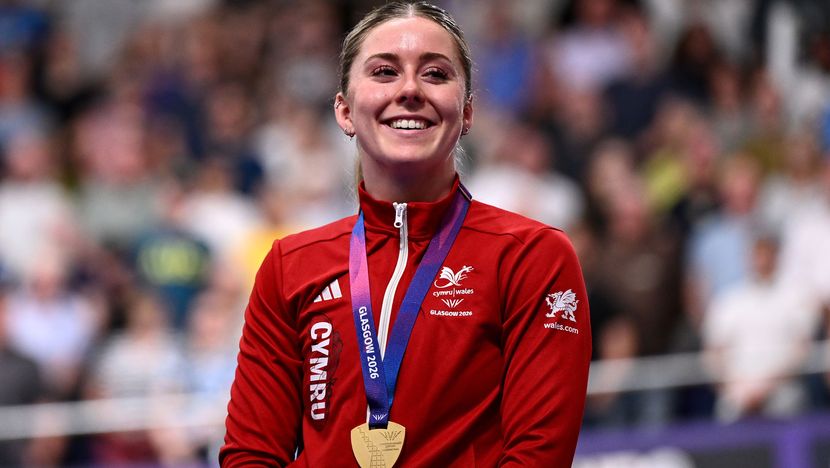
Emma Finucane arrived in Glasgow with two Commonwealth Games bronze medals. Four days later, she left with four golds.
The Welsh sprinter won the team sprint, individual sprint, 1,000m time trial and keirin at the Sir Chris Hoy Velodrome, becoming the first sprint cyclist to win four track gold medals at a single Commonwealth Games. Her final victory also made her the most successful Welsh woman at a single Games.
But Finucane's sweep was one rider's story in a programme that was, by design, bigger than any one rider.
Glasgow 2026 staged the biggest Track Cycling programme in Commonwealth Games history, with 26 medal events across Track and Para Track Cycling. Eight were Para events, twice the number contested at Birmingham 2022.
That expansion wasn't a footnote. It was the difference between competing and not competing for athletes whose classifications had previously had no event in which to compete. For the first time, the programme included C1-C3 men's and C4-C5 women's time trials and individual pursuits alongside the established tandem events.
For Scotland's Fin Graham, that changed what was possible.
“When I started my Para cycling journey, my event wasn't actually included in the Commonwealth Games,” Graham said after his selection for his first Games. “For that now to be the case, and for it to be in Scotland, is a dream come true.”
Graham went on to win bronze in the C1-C3 1,000m time trial before taking silver in the individual pursuit, where England's Matt Robertson set a Commonwealth Games record to claim the first international victory of his career.
The new events began producing history almost immediately. Australia's Tara Neyland broke the C4 world record in qualifying for the women's C4-C5 individual pursuit, recording 4:49.648 before going on to win gold, little more than a year after beginning to compete in Para cycling. New Zealand's Devon Briggs also set a Commonwealth Games record, clocking 1:05.536 in the men's C3 1,000m time trial at the first Games in which New Zealand had fielded Para Track Cycling athletes.
If Graham, Robertson, Neyland and Briggs represented opportunities that had only just become possible, Neil Fachie stood at the other end of the Commonwealth cycling story.
Fachie first competed at Delhi 2010 and had initially retired after Paris 2024. Glasgow brought him back to the track, partnered by pilot Aaron Pope and racing in the city where he had won two golds at the 2014 Games.
Victory in the tandem 1,000m time trial took him past lawn bowler Alex Marshall as Scotland's most successful Commonwealth Games athlete. Fachie then won the tandem sprint to claim a seventh Commonwealth gold in what he said would be his final race.
“What a way to bow out,” he said. “I'm quite happy to say farewell here. I love you, Scotland, and what a moment.”
History was being made across the rest of the track programme too. Finucane had been 19 when she won bronze in the individual sprint and team sprint at Birmingham 2022. Four years later, she won every sprint title available to her in Glasgow, completing the sweep by beating defending Commonwealth and Olympic champion Ellesse Andrews of New Zealand in the keirin. Fellow Welsh rider Anna Morris won the individual pursuit in a Games-record 4:24.272 before adding the points race title.
Then the final cycling gold of Glasgow 2026 went somewhere that had waited two decades for one. Matthew Bostock won the men's points race for the Isle of Man, giving the island its first Commonwealth Games cycling title since Mark Cavendish won the scratch race at Melbourne 2006.
Across four days at the Sir Chris Hoy Velodrome, the records came in different forms. Some were measured in seconds, with world and Commonwealth Games marks broken on the track. Others were written across careers and medal histories: Finucane's four-gold sweep, Fachie becoming Scotland's most successful Commonwealth Games athlete, Bostock ending the Isle of Man's 20-year wait.
But Glasgow also changed who had the opportunity to create those moments. By doubling the number of Para Track Cycling titles and bringing new classifications onto the programme, the Games opened the start line to riders who, four years earlier, would have had nowhere to race at all.
The biggest cycling programme the Commonwealth Games had ever staged did not simply create more chances to win medals. It gave more riders the chance to enter the record book.